Runewood: A Bold Fantasy Typeface for Handmade Creators
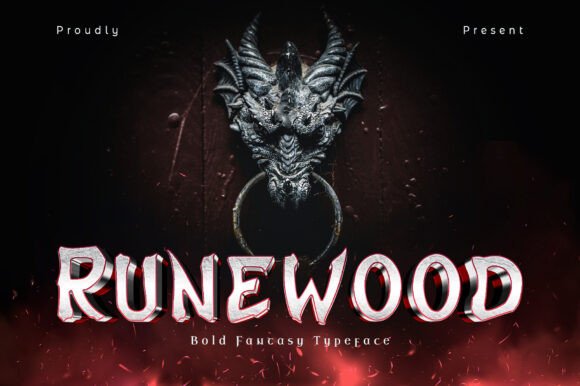
If you’ve ever spent hours tweaking a candle label only to find the font feels too soft—or tried to design a wedding welcome board that truly whispers “enchanted forest” but landed somewhere between cheerful and generic—you know how much weight the right display font carries. Runewood isn’t just another fantasy typeface. It’s a grounded, intentional tool—crafted with thick strokes, sharp angular terminals, and rune-inspired structure—that gives handmade products instant presence, depth, and narrative.
I use Runewood across my small stationery shop and digital printable business—not as a novelty, but as a workhorse for moments where tone matters most. Its visual personality is unmistakable: part ancient, part untamed, wholly confident. The jagged edges aren’t chaotic; they’re deliberate. They hold up beautifully on physical prints, cut cleanly on Cricut and Silhouette machines, and scale well from 8pt product tags to 36-inch farmhouse signs.
Where Runewood Shines in Real Craft Projects
Runewood thrives in short-form, high-impact applications—exactly where handmade sellers need reliability and emotional resonance:
- Candle & soap labels: Paired with a clean sans serif (like Montserrat or Inter) for ingredients and scent notes, Runewood anchors the brand name with authority—no extra embellishments needed.
- Wedding stationery: Use it for “Mr. & Mrs.” on invitations, “Welcome” on acrylic welcome boards, or “The Forest Awaits” on rustic kraft paper menus. It reads clearly at arm’s length and photographs beautifully in natural light.
- Seasonal packaging: Halloween apothecary boxes, Yule log candle wraps, or enchanted garden party favor tags gain instant thematic cohesion with Runewood’s grounded mystique.
- Digital printables: Planner covers, quote pages, and themed habit trackers feel elevated—not costumed—when Runewood headlines a layout designed around readability and calm whitespace.
- Mugs, totes & apparel: Because its thick strokes resist thinning during DTG printing or vinyl weeding, Runewood delivers crisp results even on textured fabrics or ceramic curves.
Readability & Production Practicality
Let’s be honest: not all fantasy fonts survive real-world production. Runewood does—because its letterforms prioritize legibility without sacrificing character. The uppercase “A,” “R,” and “K” have open counters. Lowercase letters (though best used sparingly in display contexts) maintain clear distinction. For stickers under 1.5 inches wide, I stick to all-caps Runewood phrases of three to five words—“Wild & Worthy,” “Hearth & Hollow,” “Moonlit Keep”—and always test-cut at 90% size first.
When designing mockups for Etsy listings, I preview Runewood in both dark-on-light and light-on-dark settings. Its contrast ratio holds up well, especially against charcoal kraft, deep forest green, or matte black. And unlike some ornate display fonts, Runewood doesn’t require manual kerning adjustments for common pairings like “THE” or “AND”—the spacing feels balanced out of the box.
Smart Pairings for Balanced Design
Runewood works best when paired intentionally—not as a solo act, but as the strong voice in a thoughtful duo. Here’s what I reach for most often:
- A warm handwritten font (e.g., “Lavanderia” or “Quicksand”) for body text or personal messages—softens Runewood’s intensity while keeping warmth and authenticity.
- A neutral sans serif (like “Poppins” or “Open Sans”) for product details, care instructions, or pricing—creates clean hierarchy and supports accessibility.
- A subtle serif (like “Cormorant Garamond” or “Playfair Display”) for elegant contrast in invitation suites—lets Runewood command attention while the serif handles longer passages gracefully.
Avoid pairing Runewood with other high-contrast or heavily decorated fonts—it crowds the visual field. Think of it as the lead vocalist: powerful alone, but strongest when backed by supportive harmony.
Licensing, Files & What You’ll Actually Use
Runewood is a premium font built for commercial crafters. That means its license explicitly covers use in physical products you sell (candles, mugs, greeting cards), digital downloads (printables, Canva templates), SVG files for cutting machines, and client branding projects—no hidden restrictions or attribution requirements. Always verify your license includes extended commercial rights if you’re bundling fonts into editable design templates.
The file package typically includes OTF and TTF formats—both compatible with Cricut Design Space, Silhouette Studio, Adobe Creative Cloud, and free tools like Canva and Google Fonts (via upload). Many versions include stylistic alternates (like a more angular “S” or alternate “R”), ligatures for smoother “TH” or “ST” connections, and multilingual support covering Western European languages—useful if you sell internationally or design bilingual event signage.
Why Runewood Fits Your Shop—Not Just Your Mood Board
This isn’t a font you download and forget in a folder. Runewood earns shelf space because it solves real problems: helping your brand feel cohesive across sticker sheets and wall art, giving seasonal collections narrative continuity, and making customers pause—not just scroll past. When a customer sees Runewood on your candle jar, then again on your Instagram story banner and printable gift tag, they’re not just seeing a font. They’re sensing intention. Craftsmanship. A world you’ve built—and invited them into.
It’s rare to find a display font that balances expressive power with production practicality. Runewood does both—without compromise. Whether you’re laser-cutting birch tags for a boutique line or layering SVGs for a digital planner bundle, this is the kind of typeface that makes your process smoother and your products more memorable.