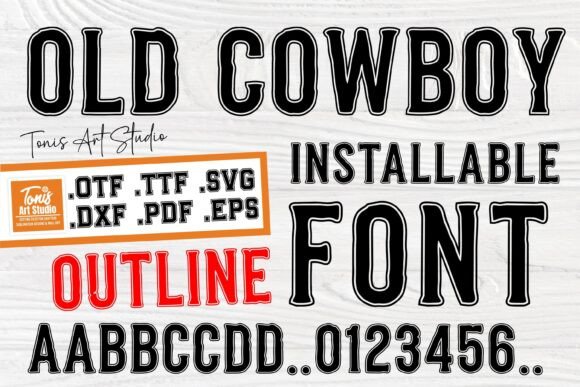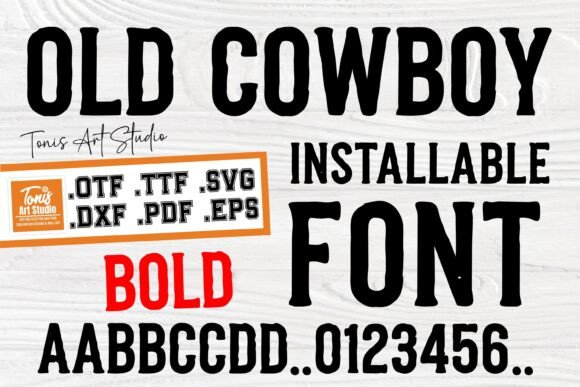
Old Cowboy Bold: A Display Font That Builds Brand Trust
As a small business owner who’s hand-painted signage, designed product labels at 2 a.m., and tweaked Instagram banners until the colors felt just right—I know how much weight a single font carries. Old Cowboy Bold isn’t just another decorative typeface. It’s a display font with clear intention: bold presence, Western-rooted authenticity, and immediate visual recognition. If your brand tells a story—whether you run a desert-themed candle shop, a vintage-inspired café, or a boot-making workshop—this font helps that story land before a single word is read.
Old Cowboy Bold has thick strokes, strong serifs, and a slightly weathered confidence. It doesn’t whisper—it declares. But unlike many expressive fonts, it avoids cartoonish exaggeration. The letterforms are balanced, legible at scale, and built for impact—not just novelty. That makes it unusually versatile for real business use: from a logo stamped on kraft paper packaging to a headline in a Facebook ad thumbnail.
I first used Old Cowboy Bold for my own line of small-batch hot sauces. We named each flavor after Arizona landmarks—“Saguaro Smoke,” “Chiricahua Fire”—and needed packaging that felt grounded, honest, and unmistakably Western without leaning into cliché. Old Cowboy Bold gave us that. On 2-ounce glass bottles, it held up beautifully at 14 pt on front labels. On our website banner, scaled large, it anchored the design without competing with photography. Most importantly, customers began recognizing the typography before they even saw our logo mark.
That’s the quiet power of consistent, intentional typography: it builds familiarity. When your business cards, thank-you stickers, and Instagram Story highlights all share the same bold, confident voice, people begin to associate that visual rhythm with your brand’s reliability. Old Cowboy Bold works especially well as a primary display font—meaning it shines in headlines, logos, product names, and signage—but it’s not meant for body copy. Use it where you want attention, clarity, and character: menu headers at your roadside diner, the title on your coaching program’s sales page, the “NEW” badge on your Etsy listing, or the tagline stitched onto your boutique’s reusable tote bags.
Readability matters—and Old Cowboy Bold delivers where it counts. On printed materials like hang tags or jar labels, its generous x-height and open counters keep letters distinct, even at smaller sizes (down to ~10–12 pt with good contrast). On mobile screens, it remains legible in social media carousels and digital ads—no squinting required. Just avoid using it for long paragraphs or fine print; pair it instead with a clean, highly readable sans serif (like Montserrat or Inter) or a warm, relaxed serif (like Merriweather or Lora) for supporting text.
Font pairing is where many small businesses get stuck—and where Old Cowboy Bold truly earns its place. Think of it as your brand’s “voice”: strong, sincere, and rooted. Then choose a “conversation partner” for everything else. For a handmade soap brand, try Old Cowboy Bold for product names (“Juniper Trail,” “Red Rock Clay”) paired with a soft, neutral sans serif for ingredients and usage instructions. A leather goods startup might use it for their logo and collection titles, then switch to a sturdy mono-spaced font for care tags. Even service-based businesses—like a leadership coach specializing in resilience—can use Old Cowboy Bold in webinar banners or workbook covers to signal strength and grounded wisdom.
Before rolling it out everywhere, test Old Cowboy Bold in context. Print a mock-up of your product label at actual size. Load a draft Instagram post into your phone and scroll past it—does it catch your eye in under two seconds? Try it over a photo background: does it retain contrast and clarity? And always check the licensing. Old Cowboy Bold is a commercial font, so verify whether your license covers physical products (like tins or apparel), digital templates you sell, client projects, or embedded use on your website. Reputable font vendors clearly state these terms—and skipping this step can lead to unexpected limitations down the road.
Real-world consistency doesn’t come from using ten different “cool” fonts across ten touchpoints. It comes from choosing one strong, expressive display font—like Old Cowboy Bold—that reflects your brand’s values, then applying it thoughtfully and repeatedly. Whether you’re updating your café’s chalkboard menu, designing a limited-edition sticker pack, or launching your first Shopify collection, this font gives you instant tonal clarity. It says, “We mean what we make—and we stand behind it.”
And that’s something no algorithm, trend, or template can replicate. It’s the kind of authenticity customers remember—and return for.